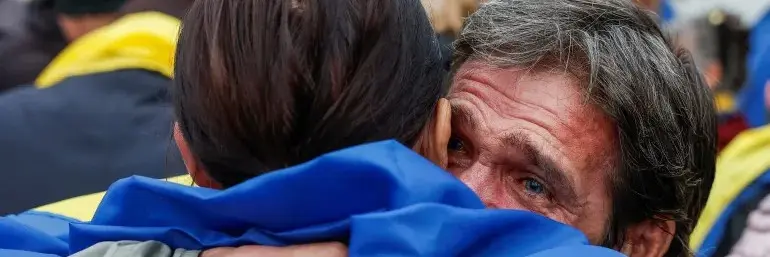
Ukrainian evacuees from Russian-occupied Oleshky reunite with family
yunus
For more than two and a half years, 19-year-old Liza Paliy lived separated from her father. When she and her family fled their southern Ukrainian hometown of Oleshky, they thought they would be gone for a couple of weeks. Instead, the front line froze, trapping her father behind Russian-controlled lines.
That agonizing separation ended in an explosion of tears and tight embraces. Paliy’s father was among hundreds of exhausted Ukrainian civilians who finally crossed back into Ukrainian-held territory, wrapping themselves in blue-and-yellow national flags after stepping off rescue buses at the border.
The emotional reunions were made possible by a rare localized ceasefire in the southern Kherson region—the most significant pause in fighting since Russia's full-scale invasion. Brokered with international diplomatic assistance, including a push from U.S. First Lady Melania Trump and Pope Leo XIV, the temporary truce quieted a deadly stretch of the Dnipro River.
The Reality Behind the Lines: Life in Oleshky
Before the evacuation, Oleshky had been reduced to a ghost of its former self. Out of a pre-war population of over 20,000, only about 2,000 residents remained as the city devolved into an active combat zone plagued by constant drone surveillance, landmines, and artillery fire.
With local shops long closed, electricity and running water cut off, and no staple food supplies arriving for months, remaining residents faced severe hardship. Evacuees reported surviving on minimal personal reserves, community vegetable patches, or wild plants just to stay alive.
Under the terms of the temporary safe corridor, de-mining crews cleared blocked roads, and a joint humanitarian operation brought in emergency food, medicine, and transport. Evacuees were given a choice: they could travel deeper into Russian-controlled territory or take a long, multi-leg transit route through Russia and Belarus to return to Ukrainian-controlled regions. Hundreds chose the journey home, bringing along whatever belongings they could carry—along with rescued pets, including dogs, cats, a parrot, and even a raccoon.
Gains, Losses, and the Ground Situation
- The Military Stalemate: On the broader battlefields, the war remains deeply entrenched. While this localized truce brought quiet to Oleshky, fighting and aerial bombardments continued elsewhere in Ukraine, showing that the macro-level conflict remains deadlocked along static front lines.
- Humanitarian Realities: For Moscow and Kyiv, the operation marked a rare logistical compromise. However, both governments noted that thousands of civilians chose to stay behind in Oleshky, tied to their homes and remaining pets despite the risks.
What This News Means for the Future
While political leaders on both sides have stressed that this specific humanitarian corridor does not automatically signal a broader peace deal or an end to the war, the successful operation carries vital symbolic and practical weight:
While political leaders on both sides have stressed that this specific humanitarian corridor does not automatically signal a broader peace deal or an end to the war, the successful operation carries vital symbolic and practical weight:
- A Blueprint for Civilian Relief: Ukrainian human rights officials have pointed out that the Oleshky evacuation proves localized cooperation to save civilian lives is technically possible, even amidst deep hostility. It could serve as a template for future rescue missions in other besieged, hard-to-reach areas.
- Shifting Diplomatic Pressures: With international figures stepping in to secure humanitarian truces, pressure mounts on warring parties to carve out protected spaces for non-combatants. Whether this builds enough trust to influence broader diplomatic talks remains to be seen, but for families torn apart by borders for years, it offers a powerful reminder of what human persistence can achieve.